[Image:81903_22607_2.png]Book resources for a presentation Minimum version: FirstClass 8.3 Audience: Business professionals Experience: [Image:9203_22631_1.png] FirstClass applications used: [Image:9203_24337_3.png][ fcp://@fc.onlinehelp.com,%237600229/En/OnlineHelp/Client Help/Calendars ]Calendars [Image:9203_31709_1.png] Summary Looking for a simple way to organize the location and resources you need for your presentation? Consider using a FirstClass calendar. Instead of sending out printed memos and filling out request forms, you can use a group calendar in FirstClass to invite participants, reserve multimedia resources, and book locations. Here is a comparison of the conventional way you may book resources and how you would do it in FirstClass. [Image:92203_31828_0.png] [Image:9203_31709_1.png] Example Michael Green is vice president of Sales and Marketing at Husky Planes. Several times a year he showcases the company's newest products for his sales staff. His presentations usually consist of a promotional videotape from the Marketing department accompanied by a slide presentation. Michael schedules the presentation, invites members of the sales department, and books the boardroom and multimedia resources all at the same time. He doesn't have to leave his office to ensure that his presentation goes off without a hitch. Here are the steps he takes to handle the arrangements: STEP 1: Schedule presentation Michael schedules the presentation in the Sales Dept Calendar by creating a new event entitled New Product Promo. This is the new event he created. [Image:8102006_91145_0.png] STEP 2: Reserve venue Each resource or location Michael wishes to book has its own calendar. When he schedules an event, he simply enters the name of the resource calendar or location calendar on the Scheduling tab of the event he is booking. If there is a time conflict, it will show immediately and he can decide how to handle it. Michael reserves the company's mid-sized boardroom using the Scheduling tab. STEP 3: Reserve resources Michael also reserves a large screen television, a video cassette recorder, and a video projector. This is the Scheduling tab where he books the resources. [Image:882006_33623_2.png] When he entered his requests on the Resources tab for the New Products Promo event, a new event appeared in each item's calendar. Husky Planes' IT department monitors the resource and location calendars and ensures that requested equipment is ready for use when scheduled. This is the calendar for the video projector that John booked. [Image:882006_32721_0.png] STEP 4: Invite participants Michael invites the members of the sales department by entering their names on the Scheduling tab. From this screen, he sees who may have a time conflict. He adjusts the date and time as needed (the booked times for the resources and locations will also change automatically). The presentation will then appear in each of their personal calendars. This is the Scheduling tab where he invites participants. [Image:882006_33910_4.png] [Image:9203_31709_1.png] Variation If Michael has content he wishes to share before the presentation, he can attach it to the calendar event at the time of scheduling or type it in the text box on the event form. This is the event he created. He attached a file for review and included an agenda in the text area. [Image:882006_32224_4.png]
   
F1018
 
 
Home  •  Help  •  Practical Uses for FirstClass  •  Developing Projects - Education  •  Project Stages  •  F1018
72203_112759_0.pngCompiling the project
Stages

Once all of the team members have collected their information and stored it in their respective project conference, they need to put it all together. As the teacher, you will ultimately decide the format of the projects and the requirements.
9203_31808_2.png Compiling projects traditionally
Traditionally, you may have students submit duotangs, notebooks, or binders, with a certain number of pages devoted to each section. Or you may request an artistic display accompanied by a presentation.
FirstClass eliminates the need for paper, and lets teams submit their projects online.
9203_31808_2.png Creating templates
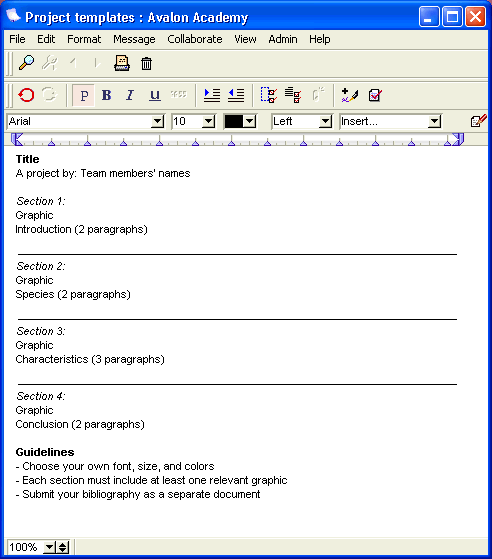
Perhaps the easiest way to convey your requirements to students is to provide a template for them. You can indicate how you want the document laid out, where you want graphics and how many, what types of content to include, and so on. Here is a sample template you can use as a guide to creating your own.
81203_111217_0.png
81203_42521_14.png Note
You can make your document read only by protecting it. This way, students won't be able to accidentally modify your template.
9203_31808_2.png Compiling projects in FirstClass
FirstClass supports graphics, text, voice, and links, making it easy for students to create any number of different types of projects. They can write stories, poems, display artwork, songs, presentations, and more; all within standard FirstClass documents.
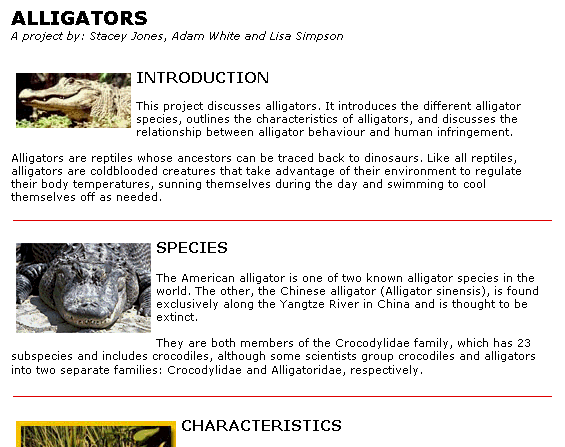
For example, if your students are doing a presentation about alligators, they can choose their font, style and color to put the body of the document together. They can add graphics wherever they want, and even attach a voice message to the document as a wav file. The voice message could be as simple as the sound of an alligator, or as complex as the reading of the entire document. This is a great idea if you wish to showcase the projects in a conference for others to view.
This is a sample project about alligators.
26042002_73632_33.png


Using links
You can use links within the document to jump between sections, or create contents at the top of the document so those who read the project can navigate through it easily.
This is the same project using links.

14082003_30118_0.png

Once the document is put together, it can be printed if required. You can request that students post their final product to a Final Product or Gallery subconference within their project conference, an Assignments conference that you set up on your own Desktop, or print out the project and submit it in hard copy.
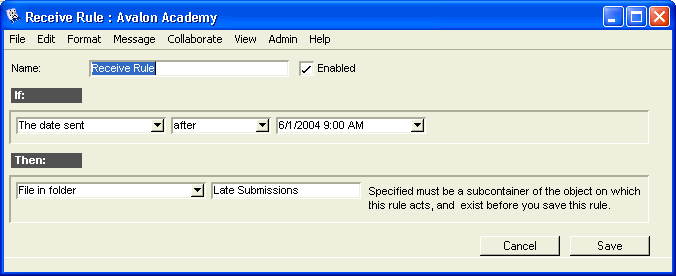
You can also use a mail rule for the Assignments subconference to handle projects that are late. You can create a Late Submissions folder inside the conference and set up a rule that says any mail received past the due date will be filed in the Late Submissions folder. This way you can penalize as necessary.
6104_13524_0.png
9203_31808_2.png The next step
Now the project is complete. You may require students to do a presentation of their projects, and you may wish to showcase the projects to peers, staff, or the community.