[Image:81903_22607_2.png]Book resources for a presentation Minimum version: FirstClass 8.3 Audience: Business professionals Experience: [Image:9203_22631_1.png] FirstClass applications used: [Image:9203_24337_3.png][ fcp://@fc.onlinehelp.com,%237600229/En/OnlineHelp/Client Help/Calendars ]Calendars [Image:9203_31709_1.png] Summary Looking for a simple way to organize the location and resources you need for your presentation? Consider using a FirstClass calendar. Instead of sending out printed memos and filling out request forms, you can use a group calendar in FirstClass to invite participants, reserve multimedia resources, and book locations. Here is a comparison of the conventional way you may book resources and how you would do it in FirstClass. [Image:92203_31828_0.png] [Image:9203_31709_1.png] Example Michael Green is vice president of Sales and Marketing at Husky Planes. Several times a year he showcases the company's newest products for his sales staff. His presentations usually consist of a promotional videotape from the Marketing department accompanied by a slide presentation. Michael schedules the presentation, invites members of the sales department, and books the boardroom and multimedia resources all at the same time. He doesn't have to leave his office to ensure that his presentation goes off without a hitch. Here are the steps he takes to handle the arrangements: STEP 1: Schedule presentation Michael schedules the presentation in the Sales Dept Calendar by creating a new event entitled New Product Promo. This is the new event he created. [Image:8102006_91145_0.png] STEP 2: Reserve venue Each resource or location Michael wishes to book has its own calendar. When he schedules an event, he simply enters the name of the resource calendar or location calendar on the Scheduling tab of the event he is booking. If there is a time conflict, it will show immediately and he can decide how to handle it. Michael reserves the company's mid-sized boardroom using the Scheduling tab. STEP 3: Reserve resources Michael also reserves a large screen television, a video cassette recorder, and a video projector. This is the Scheduling tab where he books the resources. [Image:882006_33623_2.png] When he entered his requests on the Resources tab for the New Products Promo event, a new event appeared in each item's calendar. Husky Planes' IT department monitors the resource and location calendars and ensures that requested equipment is ready for use when scheduled. This is the calendar for the video projector that John booked. [Image:882006_32721_0.png] STEP 4: Invite participants Michael invites the members of the sales department by entering their names on the Scheduling tab. From this screen, he sees who may have a time conflict. He adjusts the date and time as needed (the booked times for the resources and locations will also change automatically). The presentation will then appear in each of their personal calendars. This is the Scheduling tab where he invites participants. [Image:882006_33910_4.png] [Image:9203_31709_1.png] Variation If Michael has content he wishes to share before the presentation, he can attach it to the calendar event at the time of scheduling or type it in the text box on the event form. This is the event he created. He attached a file for review and included an agenda in the text area. [Image:882006_32224_4.png]
   
F3705
 
 
Home  •  Help  •  FOV2-0000F3E1  •  Using FirstClass ED  •  FirstClass ED for Students  •  The Student's Classroom  •  F3705
41204_42505_0.pngManaging your portfolio
Task list

9203_31904_3.pngYour portfolio
Your portfolio is a collection of your work that represents your performance. Portfolios can include
•       photographs or videos of science experiments, performances, or exhibits
•       online presentations
•       accomplishments and favorite work
•       self-critiques and peer reviews of your work.
You can also use your portfolio to
•       contain a work in progress that illustrates the creation of a product, such as an essay, as it evolves through various stages of conception, drafting, and revision
•       log progress on readings and other recurrent projects
•       involve parents in your education.
9203_31904_3.pngCollect, select, and reflect
Traditionally, you write, hand in, and forget about the assignment. Portfolios provide an easy way to save that work and are an effective way to let you take a second look and think about how you can improve future work.
When deciding what to include in your portfolio consider:
•       What would I like to reread or share with my parents or a friend?
•       What makes this a good product?
•       Will the content include one subject, or span several subject areas?
As you build a portfolio of selected pieces, you generate criteria for good work. If you are a primary student, you may simply follow guidelines set out by teachers. As a secondary student, you may brainstorm with the teacher and peers and, together set the guidelines to determine what type of work should be included.
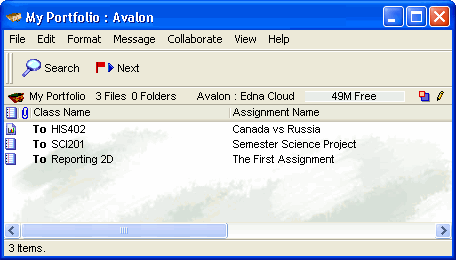
This is an example of a portfolio that spans a couple of subjects.
9202005_91945_0.png
9203_31904_3.pngHow to
Once you have decided which assignments to include in your portfolio, add them to the portfolio by dragging them from your Mailbox.
Parents can view your portfolio by logging into your account.
To share your portfolio, either move your My Portfolio folder into your My Shared Documents area, or create an alias in My Shared Documents to your portfolio.
To create an alias to your portfolio:
1 Select My Portfolio.
2 Right-click and choose Add to Desktop.
3 Drag the new My Portfolio into My Shared Documents.
81203_42521_14.pngNote
If you do not have a My Shared Documents folder on your Desktop, choose File > Open > My Shared Documents. The folder will be automatically added to your Desktop.